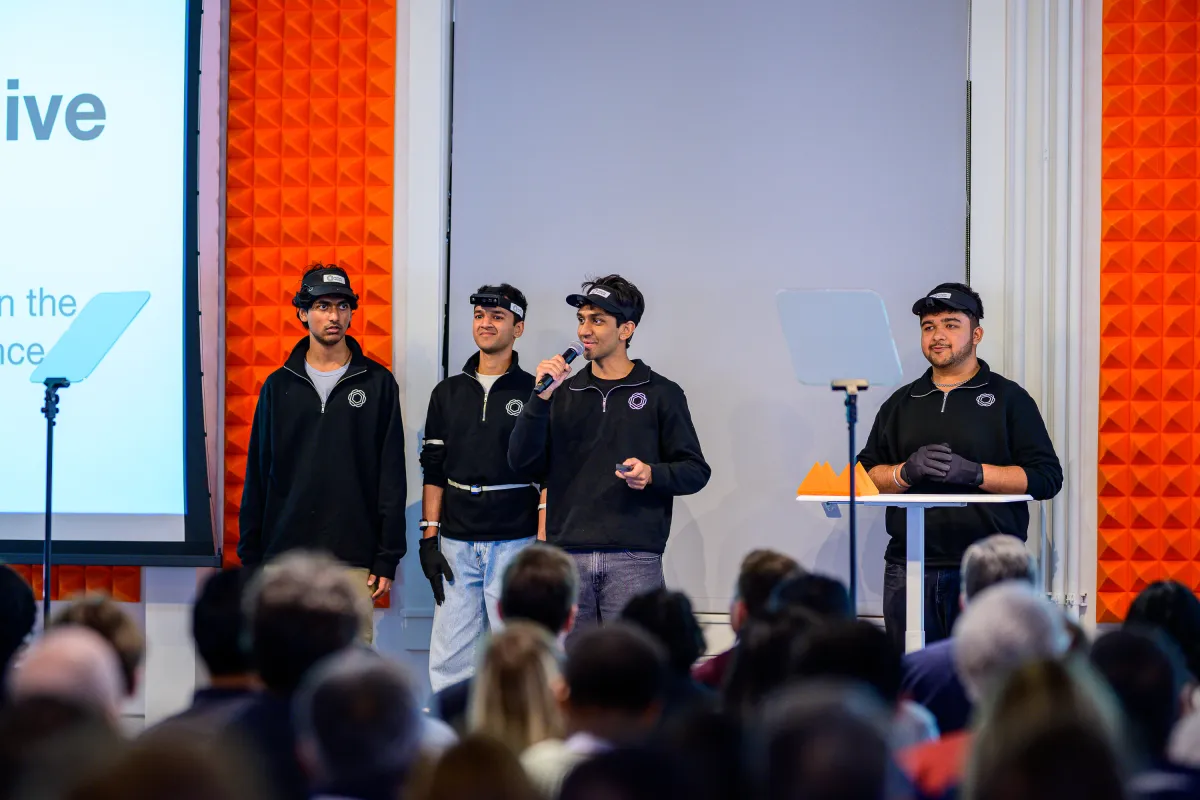
Human Archive, a Silicon Valley startup, leverages India's booming gig economy to collect real-world data, solving a major AI bottleneck.
A Silicon Valley startup is making a bold bet on India's booming gig economy to solve one of the biggest bottlenecks in artificial intelligence: training robots to understand and navigate the real world. Human Archive, founded by students from UC Berkeley and Stanford, is equipping Indian home service workers with special camera-laden caps to collect first-person video data of everyday tasks, a crucial step toward building truly intelligent physical AI.
This innovative, if controversial, approach has just landed Human Archive $8.2 million in funding from prominent investors like Wing Venture Capital, NVP Capital, Y Combinator, and a roster of angels from tech giants including OpenAI, Nvidia, Google, and Meta. The investment signals a significant push into a nascent but critical sector of AI development, with a clear human angle at its core.
The core problem Human Archive aims to solve is a global one. As robotics labs and frontier AI companies race to build machines that can perform complex physical tasks, they face a severe shortage of high-quality, real-world training data showing humans doing actual work. Think of a robot needing to learn how to fold laundry, make a sandwich, or clean a kitchen; it needs to see humans doing these tasks from a human perspective.
That's where India's rapidly growing gig economy comes in. With platforms like Zomato and Swiggy for food delivery, and Urban Company for home services, millions of workers are performing a vast array of tasks daily. Human Archive's strategy is to tap into this massive, scalable workforce to collect egocentric data, which means video recorded from a first-person point of view, exactly what a robot might "see." The startup currently has over 1,000 active headsets deployed across multiple locations, partnering with companies in the home services, hotel, and restaurant sectors.
However, the journey has not been without friction. Human Archive has faced outright rejection from some of India's major home services players, including Urban Company and Pronto, when seeking data collection partnerships. This led to a public spat on X (formerly Twitter) last weekend, with Urban Company CEO Abhiraj Singh Bhal stating his company would not engage in such arrangements, prompting Human Archive CEO Raj Patel to fire back about potential irrelevance. Co-founder Rushil Agarwal was even more direct, recounting a rejection where a Pronto founder allegedly called him "stupid" for the idea.
Why This Matters for the Future of AI and Your Privacy
The race to build physical AI is intensifying across the globe, with massive implications for industries from manufacturing and logistics to healthcare and home assistance. What Human Archive is doing is fundamental to this future. By collecting data from human workers performing real-world tasks, they are providing the raw material for robots to learn nuanced movements, decision-making, and interactions that are currently impossible to simulate or program manually.
This isn't just about video. To differentiate itself, Human Archive is developing and using a suite of advanced devices. Beyond the camera caps, workers might wear tactile gloves, full-body motion capture suits, and wrist cameras. This allows the company to capture a rich tapestry of data points, including motion and tactile force, synchronized with RGB-D (color imagery paired in real time with depth information). The belief is that simple video isn't enough; combining it with other sensor data makes it exponentially more valuable for training sophisticated AI models.
For the workers, participation means earning a base rate of $1 per hour for wearing the data-collecting gear. While this is lower than what some competitors reportedly pay in India (ranging from $2.63 to $4.20 per hour), Human Archive argues its on-the-ground presence provides immediate, flexible earning opportunities. Customers, meanwhile, are offered a discounted service price in exchange for consenting to the data collection. This creates an interesting dynamic where the incentive of cost savings helps drive the data pipeline, with the added benefit that video recordings can help resolve service quality disputes.
The Global Race for Robotic Data and Ethical Headwinds
The strategic choice of India for data collection is not arbitrary. The country's massive and rapidly expanding gig economy provides an unparalleled, scalable source of diverse human activity data.
The public rejections from major Indian companies underscore a growing debate around the ethics and implications of using human labor, particularly from vulnerable gig workers, to fuel the next generation of AI. These companies might be wary of the reputational risks, privacy challenges, or simply the long-term implications of becoming data suppliers for external AI initiatives.
Human Archive's model represents a frontier in AI development, marrying the global demand for robotic intelligence with the vast human capital of emerging economies. The ability to collect and synchronize multi-sensor data at scale is a unique advantage, as noted by Zach DeWitt, a partner at Wing VC, who highlights the intense interest from major labs and universities in experimenting with this novel dataset. The startup is also developing its own methods to fine-tune AI models with its data and test them on robots, directly demonstrating the quality and utility of its collection.
As multiple well-funded startups race to build physical AI, the access to vast amounts of high-quality training data remains the linchpin. Human Archive's approach, while innovative and backed by significant capital, will ultimately hinge on its ability to navigate complex ethical landscapes, secure partnerships, and continue to collect the unique volume and variety of data needed to satisfy the insatiable appetite of physical AI labs globally. The future of household robots and industrial automation may well be filmed through the eyes of gig workers today.
Frequently asked questions
How is India's gig economy contributing to AI development?
India's gig economy is being leveraged by startups like Human Archive to collect crucial real-world video data. Gig workers, equipped with special cameras, record everyday tasks, which is then used to train AI robots to understand and navigate human environments. This addresses a major bottleneck in AI development.
What is Human Archive?
Human Archive is a Silicon Valley startup founded by UC Berkeley and Stanford students. It aims to solve the bottleneck of AI robot training by collecting vast amounts of real-world data.
How does Human Archive collect data?
Human Archive equips Indian home service workers with camera-laden caps to record first-person video data of their daily tasks and interactions, capturing authentic real-world scenarios.
Why is real-world data important for AI robots?
Real-world data helps AI robots learn to understand and navigate complex human environments, improving their ability to perform tasks and interact safely outside controlled lab settings.
What problem does Human Archive solve in AI?
It addresses the critical shortage of diverse, real-world training data needed to make AI robots more robust and intelligent, overcoming a major bottleneck in artificial intelligence development.
Where is Human Archive based?
Human Archive is a Silicon Valley startup, leveraging talent and resources from UC Berkeley and Stanford, with its data collection operations primarily in India.