Agility Robotics opens a Digit robot training hub in Fremont, challenging Tesla and accelerating the race for versatile humanoids.
Agility Robotics is making a bold move, establishing a massive training center for its Digit humanoid robots in Fremont, California. This isn't just another facility opening; it's a direct challenge to Tesla on its home turf, signaling a critical acceleration in the race to bring versatile robots into our daily lives and workplaces. For businesses and consumers alike, this move hints at a faster path to seeing robots tackle mundane, often arduous tasks, potentially reshaping labor markets and supply chains.
Here's why Agility Robotics planting its flag in Tesla’s backyard is so significant: The new facility is located near where Tesla intends to manufacture its Optimus robots. While Tesla has visions for Optimus, Agility's Digit aims to prove its utility in commercial environments.
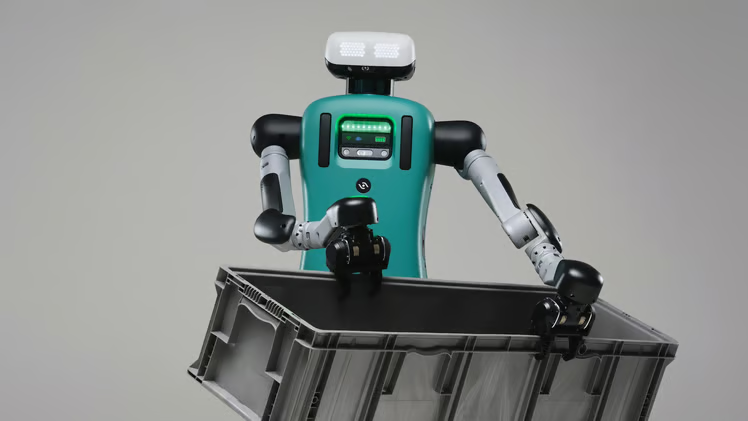
Unlike some of its highly publicized competitors, Agility aims to deploy its robots. Agility's Digit robots are intended for use in manufacturing and warehouse settings.
The company aims for commercial viability. It focuses on integrating robots into existing facilities.
Proving technology beyond the lab is important for deep tech startups.
Why Agility's Practical Approach Matters for the Ecosystem
Agility Robotics works on developing bipedal locomotion, allowing robots to safely walk on two legs.
My read on this is that Agility is taking a distinctly pragmatic approach to autonomy. While the advent of transformer-based neural networks, which power large language models (LLMs) and generative AI, promises significant advancements in robotic behavior, Agility prioritizes proven, safe, and deployable systems. This contrasts sharply with the "move fast and break things" mentality often associated with pure AI plays, especially when it comes to physical robots operating in human spaces.
Agility's approach emphasizes a robust safety framework for robots. Building a robust, deterministic safety "stack" first, then layering AI for advanced behaviors, is, the author believes, a crucial differentiator for rapid commercial adoption in regulated industries.
This focus on practicality is what gives Agility an edge in today's venture landscape. Investors, particularly in deep tech, are increasingly demanding clear paths to revenue and demonstrable commercial traction. While AI breakthroughs are exciting, the ability to integrate robots safely and effectively into existing industrial workflows, without requiring massive infrastructure overhauls, is what truly unlocks value. The humanoid form factor itself is a massive advantage because our world is already designed for two-legged, two-armed workers.
The Competitive Dance in the Humanoid Robot Race
The decision to set up shop in Fremont isn't merely about proximity; it’s a strategic declaration in the high-stakes world of humanoid robotics. It places Agility directly in the orbit of Tesla's ambitious Optimus project. This creates a fascinating dynamic, pitting Agility's strategy against Tesla's long game, and it’s a battle the author is watching closely from a founder’s perspective.
The market for humanoid robots is still nascent, but the potential is enormous. The confluence of global labor shortages, particularly in demanding physical roles, coupled with advancements in AI and robotics, is fueling a massive wave of investment. Companies are desperate for solutions that can enhance productivity, improve safety, and provide consistent labor without the complexities of human resource management.
The market is signaling confidence that it is ready to embrace this technology at scale. This also means more scrutiny and pressure to deliver, but for a company aiming to accelerate growth and capture market leadership, it is a calculated risk.
The competition isn't just between Agility and Tesla. However, the true winners in this space will be those who can move beyond impressive lab demos to reliable, scalable commercial deployments. Agility’s approach, focusing on specific industrial use cases first, positions it strongly for that transition.
The "training center" concept itself speaks volumes about the future of robotics. It's not just a manufacturing plant; it's a hub for iterative development, refinement of robot behaviors, and most importantly, where human operators will learn to effectively collaborate with these machines. This facility will be crucial for scaling up production, adapting Digit for diverse customer needs, and evolving the ecosystem around human-robot collaboration.
In essence, this move by Agility Robotics is more than just an expansion; it’s a strategic declaration in the burgeoning humanoid robotics market. As the sector matures, expect to see more of these direct confrontations, as companies vie for market leadership, talent, and investor confidence. For founders and investors watching this space, Agility’s practical approach offers a compelling blueprint for how to scale deep tech in an increasingly competitive world. The next few years will define who truly leads the charge in bringing intelligent, human-scale automation to the global economy.
Frequently asked questions
What is Agility Robotics doing in Fremont?
Agility Robotics is opening a large training center for its Digit humanoid robots in Fremont, California, signaling a direct challenge to Tesla on its home turf. This facility will accelerate the development and deployment of versatile robots.
Why is Agility Robotics' move a challenge to Tesla?
Establishing a major robot facility in Tesla's home city of Fremont positions Agility Robotics as a direct competitor in the burgeoning humanoid robot market, where Tesla also has ambitions with its Optimus robot.
What are Digit humanoid robots?
Digit robots are bipedal humanoid robots developed by Agility Robotics, designed for versatile tasks in logistics, manufacturing, and other environments, capable of navigating human-centric spaces.
How will this impact the robotics industry?
This move intensifies competition in the humanoid robotics sector, potentially accelerating innovation, reducing development timelines, and bringing versatile robots to market faster for businesses and consumers.
Where is Agility Robotics headquartered?
Agility Robotics is headquartered in Corvallis, Oregon. The Fremont facility is a new training and deployment center.
What is the significance of Fremont for robotics?
Fremont, California, is a hub for automotive and technology innovation, notably home to Tesla's main factory, making it a strategic location for companies like Agility Robotics to establish a presence and vie for talent and market share.