Amazon invests €10 billion in European logistics, launching its advanced Proteus warehouse robot to boost efficiency and create 25,000 jobs across the continent.
Amazon.com has announced a substantial €10 billion investment across its European logistics network, coinciding with the unveiling of its next-generation Proteus warehouse robot. This strategic capital allocation and technological advancement signals the e-commerce giant's intensified focus on operational efficiency and customer delivery speed, potentially recalibrating competitive dynamics within the global logistics sector and influencing future labor market structures.
The multinational technology company detailed plans to create 25,000 new jobs within its European fulfillment centers, a move designed to augment its workforce while simultaneously expanding its AI-driven robotics deployment. This dual strategy was showcased at Amazon’s ‘Delivering the Future’ event in London, where executives underscored the increasing integration of artificial intelligence and advanced robotics as foundational elements of warehouse operations.
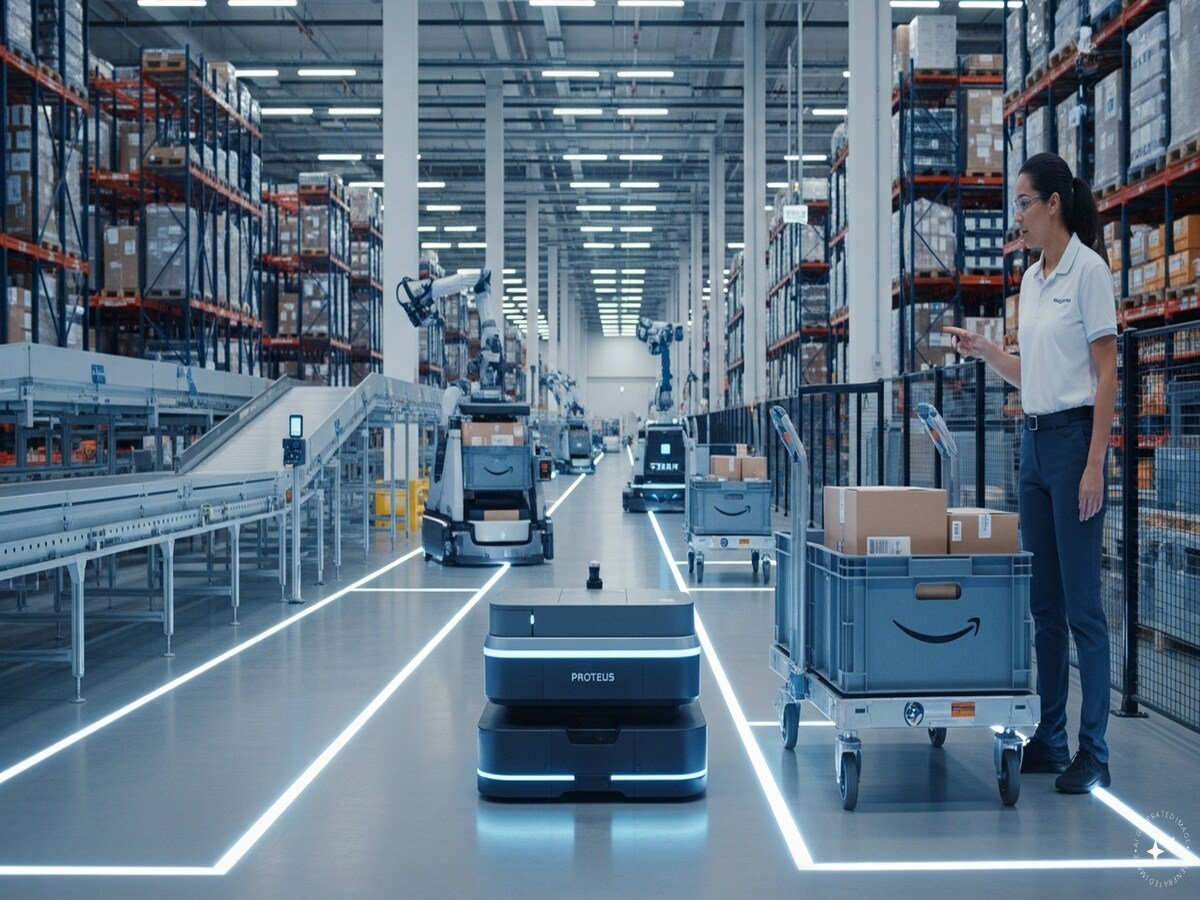
At the core of the technological push is Proteus, an autonomous mobile robot engineered for the movement of heavy materials and carts within warehouse environments. The upgraded iteration of Proteus distinguishes itself from its predecessors by its capacity to operate across entire facilities and interpret natural-language commands. This conversational interface allows employees to interact with the robot by assigning tasks verbally, akin to delegating to a human colleague, with the system autonomously optimizing routes, prioritizing assignments, and managing timelines. This advancement targets the reduction of physically demanding tasks, including the transportation of carts weighing up to 400 kilograms, repetitive lifting, and extensive long-distance movement within Amazon’s vast fulfillment infrastructure.
Beyond Proteus, Amazon is scaling its Vulcan robotic system, which incorporates a "sense of touch" for precise object identification and handling within densely packed storage areas. Initially developed and deployed in the United States, Vulcan is now operational in Amazon’s Hamburg facility in Germany, enhancing advanced picking capabilities. Additionally, the STARK collaborative tote-handling robot, designed to work alongside human employees to mitigate strenuous lifting, is slated for rollout to 15 European sites by 2027, following successful pilot programs in Barcelona.
What It Means
Amazon's dual commitment to significant capital expenditure and advanced automation represents a critical strategic inflection point, poised to enhance supply chain resilience and drive substantial operational leverage. The integration of generative AI-style interfaces into robotics, as exemplified by Proteus, could fundamentally alter the human-machine interaction paradigm within industrial settings, lowering the technical proficiency barrier for frontline workers and fostering a more collaborative automation environment.
This initiative directly addresses long-standing criticisms regarding automation's impact on employment, with Amazon asserting that its investment in robotics generates new job categories in specialized fields such as maintenance, engineering, and system reliability. For investors, this balanced approach to technological advancement and workforce expansion may indicate a sustainable path to enhanced productivity, mitigating potential public relations risks associated with extensive automation while securing the necessary human capital for complex operational oversight.
The comprehensive deployment of these advanced systems across Europe is expected to yield substantial efficiency gains, translating into faster order fulfillment cycles and reduced per-unit handling costs. In a fiercely competitive e-commerce landscape, where delivery speed and cost-effectiveness are paramount differentiators, these investments reinforce Amazon's strategic positioning and capacity for market dominance. The ability to move goods faster and more reliably also provides a crucial advantage in managing fluctuating consumer demand and navigating potential supply chain disruptions.
Amazon's €10 billion investment in Europe underscores a major capital commitment, targeting enhanced logistics infrastructure and advanced robotics deployment across the continent.
Background
Amazon has consistently been at the vanguard of warehouse automation, with robotics having been an integral component of its fulfillment centers for over a decade. This latest investment and technological unveiling signify the company’s next evolutionary phase, moving beyond conventional robotics to incorporate sophisticated AI capabilities that enable more intelligent and adaptable machine operations. The timing aligns with a broader industry trend where global logistics and e-commerce entities are increasingly channeling capital into AI-led supply chain optimizations, driven by escalating delivery expectations and rising labor costs.
The company's history of deploying advanced technologies first in its established markets, then gradually integrating them into emerging global operations, suggests that these European advancements could eventually inform and influence its logistics strategies in other key regions. Amazon’s continued expansion of its logistics and fulfillment infrastructure in markets like India, for example, often mirrors innovations proven in its global operations, indicating a potential trickle-down effect for these next-generation systems.
The rollout of next-generation Proteus robots across Europe is slated for the first half of 2027, with the system currently undergoing advanced piloting in Amazon’s dedicated laboratories. Concurrently, the STARK collaborative robot is projected to be operational in 15 European facilities by 2027, further solidifying the company's commitment to augmenting human-robot collaboration. Investors and market observers will closely monitor the deployment timelines and the quantifiable impact of these technologies on operational metrics, including delivery times, labor productivity, and overall cost efficiencies, as Amazon continues to refine its global fulfillment network.
Frequently asked questions
What is Amazon's new Proteus robot and its purpose?
Amazon's new Proteus robot is a next-generation autonomous mobile robot designed to automate material handling in fulfillment centers. It aims to improve operational efficiency, reduce manual tasks, and enhance delivery speed across Amazon's European logistics network.
How much is Amazon investing in Europe?
Amazon is investing €10 billion across its European logistics network.
How many jobs will Amazon's investment create?
The investment is planned to create 25,000 new jobs across Europe.
Where will Amazon's investment primarily focus?
The investment will primarily focus on Amazon's European logistics network, including fulfillment centers and delivery stations.
What is the significance of the Proteus robot?
The Proteus robot signifies Amazon's intensified focus on advanced automation and AI to boost operational efficiency and customer delivery speed.
Which countries will benefit from Amazon's Europe investment?
The investment is planned for Amazon's European logistics network, benefiting countries across the continent where Amazon operates.