Reliance-backed Addverb Technologies aims to raise over $100M to develop humanoid robots, AI, and become a top 10 global robotics firm.
A fascinating development is unfolding in the world of industrial automation and artificial intelligence, one that has significant implications for how products are made, stored, and moved globally. An Indian robotics startup, Addverb Technologies, already backed by the formidable Mukesh Ambani's Reliance Industries, is now on a mission to raise over $100 million to supercharge its expansion, specifically targeting the cutting edge of humanoid robots and advanced AI.
Here’s what happened: Addverb, a company that has quietly become a significant player in warehouse automation and logistics robotics, is gearing up for a major capital infusion. This isn't just about scaling existing operations; it's a strategic leap into the highly competitive, capital-intensive realm of humanoid and quadruped robots, alongside bolstering its AI capabilities for more sophisticated machine learning and data collection.
Founded in 2016 by four engineers who cut their teeth at Asian Paints, Addverb initially focused on automating the mundane yet critical tasks within warehouses, from sorting and material movement to packaging. Their robots are already integral to operations for major Indian corporations like Lenskart, Hindustan Unilever, and, naturally, Reliance itself. The company’s ambition isn't confined to its home turf, however; it generates half its revenue internationally, with a growing presence in markets like the United States, the Netherlands, and Australia.
This funding round marks Addverb's first major external capital raise since 2021, when Reliance injected $132 million, securing a controlling stake. That initial investment was a clear signal of serious intent, transforming Addverb from a promising startup into a strategically important asset. Now, with CEO Sangeet Kumar openly stating the company’s aim to be among the world's top 10 robotics firms within five years—and top 5 in a decade, up from its current position just outside the top 30—the stakes are considerably higher.
For me, what’s particularly striking here isn't just the dollar amount, significant as it is. It's the conviction and the strategic backing that an Indian deep tech company is demonstrating on the global stage, directly challenging established players from manufacturing powerhouses like China, Japan, and the United States.
Why This Matters
This isn't just a corporate funding announcement; it’s a critical data point in the evolving narrative of global innovation and supply chain resilience. For consumers and businesses in North America and beyond, the automation of logistics and manufacturing has become a non-negotiable imperative, accelerated by the pandemic-induced supply chain disruptions and persistent labor shortages. Robots like Addverb’s are the unsung heroes making sure your packages arrive on time and that essential goods are produced efficiently. When a company like Addverb expands its capabilities, it ripples across the global economy, potentially impacting everything from e-commerce fulfillment to factory floor productivity.
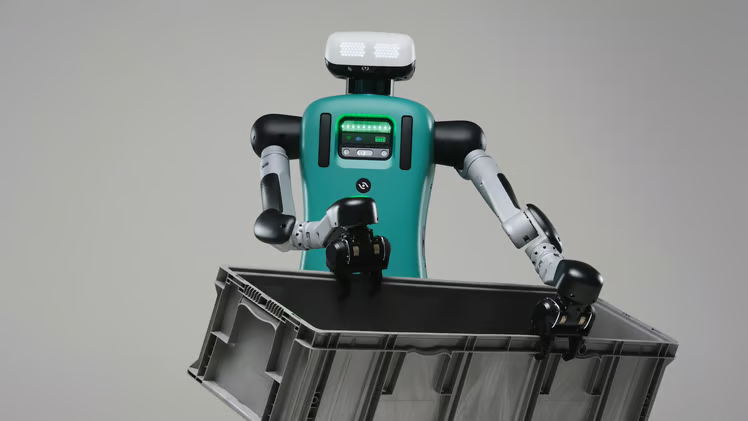
The global robotics market is projected to grow exponentially, driven by factors like the increasing adoption of automation in manufacturing, the rise of e-commerce, and the burgeoning demand for service robots. Within this landscape, the push into humanoid robots is a particularly bold move. We’ve seen incredible advancements from companies like Boston Dynamics with their Atlas, Agility Robotics with Digit, and Figure AI, which recently secured significant funding from a consortium including Microsoft, Nvidia, and Jeff Bezos. These investments reflect a widespread belief that general-purpose humanoid robots are not a distant sci-fi fantasy but an emerging reality, poised to revolutionize tasks currently performed by humans in everything from warehouses to hazardous environments.
From an ecosystem insider's perspective, the backing of Reliance Industries isn't just about capital; it’s about strategic leverage. Traditional venture capital, while crucial for early-stage innovation, often comes with a different set of expectations and timelines. For a deep tech company like Addverb, which requires significant upfront investment in R&D, manufacturing infrastructure, and long sales cycles, having a strategic behemoth like Reliance provides patient capital, unparalleled market access within India, and the sheer gravitas needed to compete globally. This kind of "smart money" is a game-changer for deep tech startups in emerging markets, allowing them to think bigger and longer-term than many pure-play VCs might allow.
Moreover, Addverb's journey highlights a burgeoning trend: India's increasing prowess in deep tech and hardware. While often celebrated for its software services and IT talent, the country is now making significant strides in manufacturing and advanced engineering. Addverb's emphasis on developing proprietary technology, such as lidar sensors, to reduce reliance on imported components, underscores a broader strategic imperative for many nations to build self-sufficiency and IP in critical technology areas. This move not only enhances their competitiveness but also addresses supply chain vulnerabilities, a lesson harshly learned by many during recent global disruptions.
What Happens Next
The immediate plan for the fresh capital is clear: accelerate development of next-generation products, including humanoid and quadruped robots, and significantly invest in data collection and AI systems. Training sophisticated machines requires vast amounts of real-world data, and building the algorithms to interpret and act on that data is where the true competitive advantage will lie. Addverb’s CEO, Sangeet Kumar, believes Indian companies can carve out their own competitive niche in the humanoid market, even against well-funded Chinese firms that often benefit from government subsidies.
The development of proprietary technology like lidar sensors is a strategic imperative. Lidar, or Light Detection and Ranging, is a crucial component for autonomous navigation in robots, enabling them to map their environment and detect obstacles with high precision. By developing these in-house, Addverb not only gains greater control over its supply chain and costs but also strengthens its intellectual property, which is vital for long-term global leadership. This focus on vertical integration in key components is a hallmark of companies aiming for true innovation and market dominance rather than just assembly.
Financially, Addverb has faced the reality of aggressive international expansion, reporting losses over the past two years. However, Kumar projects a return to profitability on an adjusted basis in the fiscal year through March 2027, with net profit anticipated the following year. This fiscal year, the company expects revenue to hit 13 billion rupees (approximately $136 million), backed by a robust order book of about $200 million. These numbers, while still modest compared to some global giants, indicate a healthy growth trajectory and a path to sustainable operations.
Looking further ahead, an initial public offering (IPO) remains a key option for Addverb to achieve greater scale, though it's not an immediate priority. Kumar has stated that an IPO would likely be considered when the company's revenue reaches 40 billion to 50 billion rupees, a milestone he believes could be achieved within the next two years at the current growth rate. This signals a confident, disciplined approach to scaling, prioritizing fundamental business growth and market position over a premature public debut.
The journey of Addverb Technologies is a microcosm of the larger story of global innovation, where technological prowess, strategic funding, and audacious ambition converge. It’s a testament to the idea that deep tech leadership can emerge from diverse geographies, bringing new perspectives and solutions to universal challenges. For North American industries facing automation needs, Addverb represents a formidable new contender, poised to deliver advanced solutions that could redefine efficiency and productivity in the years to come. The rise of companies like Addverb is not just about robots; it's about the future of work, the resilience of our supply chains, and the relentless march of human ingenuity.
Frequently asked questions
What is Addverb Technologies seeking to achieve with its new funding?
Addverb Technologies aims to raise over $100 million to expand its development of humanoid and quadruped robots, build artificial intelligence systems, and strengthen its position in advanced automation. The company seeks to become a top 10 global robotics firm within five years.
Who is backing Addverb Technologies?
Addverb Technologies is backed by billionaire Mukesh Ambani's Reliance Industries Ltd., which secured a controlling stake in the firm with a $132 million investment in 2021.
What types of robots does Addverb Technologies develop?
Addverb Technologies currently develops robots for sorting, material movement, and tasks in logistics, warehouses, and electronics companies. They are expanding into humanoid and quadruped robots, as well as developing lidar sensors.
What are Addverb's global ambitions?
Addverb Technologies aims to rank among the world's top 10 robotics firms within five years and top 5 within ten years. The company currently generates half its revenue from outside India.
When does Addverb Technologies plan for an IPO?
Addverb Technologies has no immediate plans for an IPO, deeming itself currently too small. CEO Sangeet Kumar suggests an IPO would be considered when revenue reaches 40 billion or 50 billion rupees.
How does Addverb plan to compete with larger global rivals?
Addverb plans to boost competitiveness by developing proprietary technology, reducing reliance on imported components (like upcoming lidar sensors), and focusing on emerging markets like humanoids where they believe Indian companies can find competitive strengths.