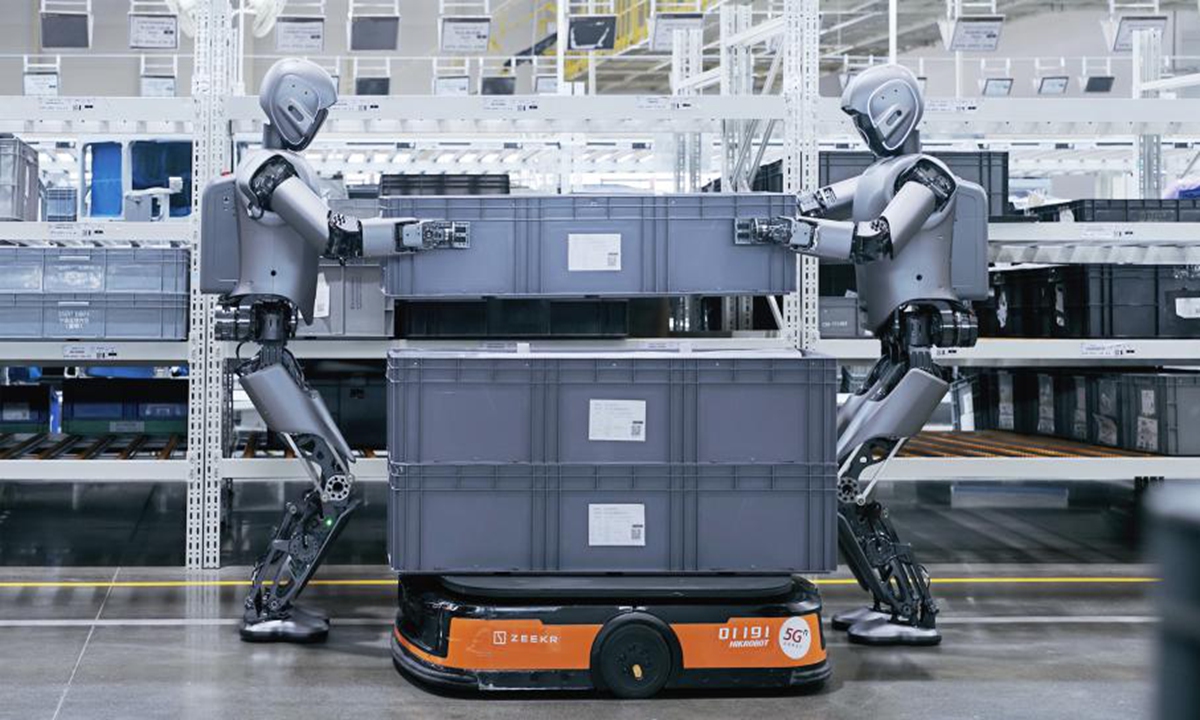
EU, ASEAN primary destinations; trend shows China's manufacturing upgrading with diversified products and tech innovation.
China's robotics sector just hit a new gear, exporting a staggering 10.377 million units worth nearly 20 billion yuan ($2.98 billion) between January and May this year alone, signaling a formidable escalation in its global tech footprint.
This isn't just about raw volume; it signals a critical pivot for Beijing's manufacturing strategy, moving firmly into high-value tech and directly impacting the competitive landscape for automation startups globally, particularly for those in North America eyeing the lucrative industrial and service robotics markets.
The sheer scale is evident in the product mix: cleaning robots alone accounted for over 70 percent of that export value, hitting 14 billion yuan, yet industrial and emerging bionic robots are also rapidly expanding their global footprint, demonstrating a diversified and technologically advanced export portfolio.
While the numbers are impressive, the long-term sustainability of this export surge will hinge on more than just aggressive pricing; questions around intellectual property, data security, and the persistent geopolitical landscape remain critical undercurrents for any global enterprise.
This export explosion isn't happening in a vacuum. The global push for automation, driven by persistent labor shortages, rising manufacturing costs, and an insatiable demand for efficiency across industries, has created fertile ground, and China's ability to rapidly scale diverse robotic solutions is now a major force shaping that future.
The primary destinations for these robot exports—the European Union and ASEAN nations—underscore a strategic alignment with regions seeking to bolster their manufacturing capabilities and service sectors with cost-effective, high-performance automation. For European industries battling high labor costs and ASEAN’s rapidly industrializing economies, Chinese robots offer a compelling value proposition.
This is more than just a trade statistic; it represents a significant upgrade in China's manufacturing capabilities. Experts in Beijing are touting this shift as a progression from the "old three" to the "new three" and now the "future three" export categories, with robotics, characterized by precision transmission, electronic control, and intelligent algorithms, firmly anchoring the high-value end.
The narrative from within China’s tech circles is one of deep structural transformation. Their complete industrial system and supply chain allow for rapid iteration and customized production, capabilities honed in a vast domestic market and now deployed globally with remarkable responsiveness.
For founders and VCs in North America, this trend isn't just about distant competition; it’s a direct challenge and a potential opportunity. Chinese robotics firms like Keenon Robotics, which claims a 22.7 percent share of global commercial service robot shipments, are not merely shipping hardware; they're establishing mature global deployment networks, including operations in the U.S.
Dobot, another player, is accelerating its overseas push in collaborative robotics, with applications spanning automotive, 3C electronics, semiconductors, and even surgical healthcare. Their 31.7 percent year-on-year revenue rise in 2025 and global leadership in collaborative robot shipments suggest a trajectory that demands attention from any competitor or investor in the space.
My read is that this isn't simply about cheap labor anymore. We're seeing sophisticated, scenario-based adaptation at play. Cleaning robots are being designed for the differentiated residential environments from large American homes to compact Japanese apartments, and industrial robots are tailored for both cost-sensitive ASEAN factories and the high-precision demands of the EU.
China’s staggering 20-billion-yuan robotics export surge signals a profound shift that goes far beyond raw shipping volume. The real narrative isn't cheap consumer hardware; it is the structural evolution into the "future three" export tier, driven by deep supply chain integration and scenario-based agility. By rapidly iterating customized automation for the labor-starved EU and industrializing ASEAN markets, Chinese firms like Dobot and Keenon are establishing mature global footprints. For North American founders and VCs, this is an immediate wake-up call. The competitive playbook can no longer rely solely on algorithm superiority or hardware innovation. Western startups must quickly fortify their defensive moats around local deployment networks, data security, and ecosystem trust before they are entirely out-scaled by China’s high-precision, low-friction manufacturing machine.
This capability to shift from product sales to delivering integrated solutions, with strong localized application capabilities, is a crucial differentiator. It implies that these companies aren't just selling a box; they're selling an ecosystem, often at a price point that established Western players struggle to match.
A significant driver behind this ascent is the deepening self-reliance in core robotics technologies. Key components, once dominated by foreign suppliers—precision reducers, servo motors, controllers—are now seeing scaled domestic substitution. The performance is reportedly reaching international benchmarks, and critically, at a cost-performance advantage.
Data from China's Academy of Information and Communications Technology suggests that the localization rate of core components in humanoid robots exceeded 75 percent as of the first quarter of 2026. Morgan Stanley reports the supply chain localization rate for humanoid robots has surpassed 90 percent.
This internal strength is mirrored by the sheer scale of the domestic ecosystem. An official report from the National Data Administration indicated that China had over 140 complete robot manufacturers and more than 330 humanoid robot products released in 2025. Industrial robot output surged 28 percent year-on-year, while service robot production hit 18.581 million units, up 16.1 percent.
The ecosystem supporting this growth is vast, with approximately 1 million active and existing robot-related enterprises across the country. In 2025 alone, there were 744 investment deals in embodied intelligence and robotics, totaling 73.54 billion yuan in financing. This kind of capital infusion and entrepreneurial density fosters rapid innovation and market deployment.
For North American venture capitalists, this presents a complex calculus. Do you double down on domestic innovation, betting on superior software or niche applications? Or do you look for opportunities to invest in companies that can either compete head-on or find synergistic ways to integrate with the burgeoning Chinese supply chain?
The fact that China’s industrial robot exports grew by 48.7 percent in 2025, exceeding imports for the first time, officially making the country a net exporter of industrial robots, is a turning point. It's not just about consumer gadgets anymore; it's the foundational machinery of global industry.
This shift will inevitably lead to increased competition for North American robotics startups, especially those operating in hardware-intensive segments. It also pushes the conversation beyond pure technological advancement to the critical importance of vertically integrated supply chains and rapid manufacturing capabilities—areas where China has a distinct, proven advantage.
The trajectory suggests a future where Chinese robotics will not just be a cost-effective alternative but a foundational element of the global automated economy, demanding a strategic response from every player in the tech ecosystem.
Frequently asked questions
What is the total value of China's robot exports from January to May this year?
China's robot exports reached nearly 20 billion yuan ($2.98 billion) from January to May. This includes 10.377 million units shipped to over 150 countries and regions globally.
Which regions are the primary destinations for China's robot exports?
The European Union (EU) and ASEAN countries are identified as the primary destinations for China's robot exports. This is driven by factors like industrial automation demand and the China-ASEAN free trade framework.
What types of robots are China exporting the most?
Cleaning robots dominate China's robot exports, accounting for over 70 percent of total exports with a value of 14 billion yuan. Industrial robots and intelligent bionic robots are also significant export categories.
How is China's manufacturing sector upgrading through robot exports?
China's manufacturing is upgrading by shifting from labor-intensive to technology-intensive and higher value-added products, driven by robotics. This involves advancements in precision transmission, electronic control, and intelligent algorithms, alongside increasing self-reliance in core components.
What role does self-reliance in core technologies play in China's robot export growth?
Rising self-reliance in core technologies, such as precision reducers, servo motors, and controllers, is a key driver. Domestic substitution has scaled up, reaching international performance levels and providing a cost-performance advantage.
Can you name some major Chinese robotics companies expanding globally?
Keenon Robotics, Dobot, Fourier, and Booster Robotics are prominent Chinese companies expanding globally. Keenon Robotics leads in commercial service robot shipments, while Dobot excels in collaborative robotics and Fourier in wellness robotics.