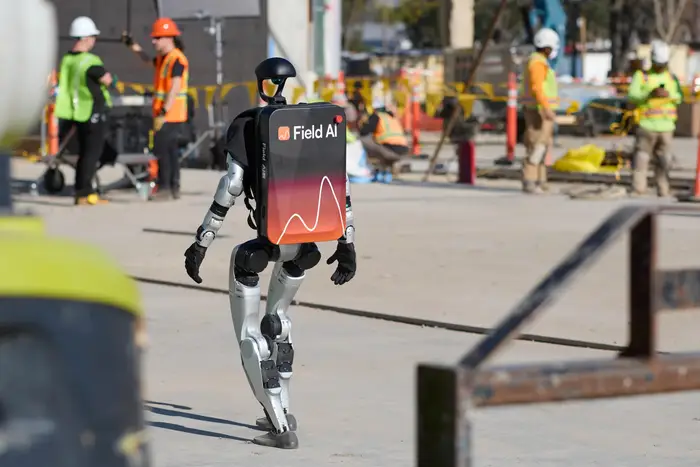
FieldAI, a North American robotics startup, achieves a significant $100 million valuation, signaling AI's rapid expansion into factories and infrastructure.
A quiet revolution has been building in the industrial heartland, and a recent milestone from FieldAI, a North American robotics startup, just sent a clear signal that it's hitting prime time. This isn't just another tech headline; it's a marker for how artificial intelligence is moving beyond our screens and into our factories, warehouses, and critical infrastructure, fundamentally changing how everyday goods are made and delivered.
Here's what happened: FieldAI, a company that has been steadily making inroads with its advanced autonomous robotic systems, has officially hit a $100 million milestone. While the specifics of this milestone—whether it's a valuation, a significant funding round, or a revenue target—aren't publicly detailed, in the startup world, reaching such a figure indicates substantial investor confidence and demonstrable market traction. It signals that FieldAI is not just building cool tech; it's building a commercially viable, scalable business that is solving real-world problems for some of the biggest industrial players.
This isn't a surprise to those of us watching the deep tech space. For years, the promise of AI-powered robotics has felt just around the corner, often bogged down by technical hurdles, integration complexities, and the sheer cost of deployment. FieldAI appears to have cracked a crucial part of that code, focusing on practical, adaptable solutions that integrate seamlessly into existing operations rather than demanding a complete overhaul. Their approach is less about replacing humans wholesale and more about augmenting capabilities, tackling repetitive, dangerous, or precision-intensive tasks that are ripe for automation.
The company's success is rooted in its ability to combine sophisticated AI algorithms with robust hardware, enabling robots to perceive, reason, and act autonomously in dynamic, unstructured industrial environments. Think about logistics hubs where goods constantly shift, or massive manufacturing plants requiring continuous inspection and maintenance. These are environments where traditional, pre-programmed robots often struggle, but where FieldAI's systems, with their ability to learn and adapt, truly shine. It's a significant shift from the fixed-arm robots of yesterday to truly intelligent, mobile, and collaborative machines.
The North American market, with its aging infrastructure, persistent labor shortages, and renewed focus on supply chain resilience, has become a fertile ground for companies like FieldAI. Manufacturing and logistics operations are under immense pressure to boost efficiency, reduce costs, and maintain a competitive edge globally. Automation is no longer a luxury; it's a strategic imperative. This $100 million milestone isn't just about FieldAI; it's a bellwether for the entire industrial automation sector, indicating that smart money is pouring into solutions that deliver tangible ROI.
Why This Milestone Matters For The Wider Ecosystem
From an ecosystem-insider perspective, FieldAI's achievement is a powerful validation for the entire industrial AI and robotics sector. For founders navigating the often-treacherous journey of deep tech commercialization, this is an encouraging signal that patient capital is available for ventures tackling complex, real-world challenges. It tells us that investors are becoming more comfortable with the longer development cycles and higher capital requirements of hardware-software integration, provided the market opportunity is vast and the technology genuinely disruptive.
What strikes me here is the clear trend line it establishes: the future of industrial work isn't just about automation; it's about intelligent automation. Companies are moving past basic mechanization to deploy systems that can reason, predict, and adapt. This means more than just faster production lines; it means higher quality control, predictive maintenance that prevents costly downtime, and safer working conditions for human employees. The human angle here is profound: while some fear job displacement, the reality is often job transformation, with humans moving into roles of oversight, management, and higher-level problem-solving that leverage their unique cognitive abilities.
This success also underscores a broader shift in venture capital. For years, consumer tech dominated the funding landscape. Now, we're seeing a healthy rebalancing towards deep tech—AI, biotech, advanced materials, and robotics—that addresses fundamental economic and societal needs. Investors are seeking defensible intellectual property and solutions that can scale across massive, often underserved, industrial markets. FieldAI's milestone will undoubtedly galvanize further investment into adjacent areas, from sensor technology and edge computing to specialized AI models for different industrial verticals.
The Road Ahead: What's Next for Industrial AI
FieldAI’s journey to this $100 million mark isn't just a testament to their technology; it's a blueprint for what's coming next in the broader industrial AI landscape. We're on the cusp of a true democratization of robotics, where these advanced systems become more accessible, easier to deploy, and more integrated into the daily fabric of operations for businesses of all sizes, not just the Fortune 500.
I anticipate we'll see a significant acceleration in the development of modular, interoperable robotic solutions. This means companies won't have to invest in bespoke, single-purpose robots, but rather in flexible platforms that can be adapted for multiple tasks and integrated with various third-party tools. The focus will increasingly be on "robot-as-a-service" models, lowering the entry barrier for businesses hesitant about large upfront capital expenditures. This shifts the risk and maintenance burden from the end-user to the robotics provider, a model that has proven highly successful in the software world.
Moreover, the next wave will heavily emphasize human-robot collaboration, or "cobots." These aren't just robots that work *alongside* humans, but systems designed to intuitively understand and respond to human actions, making industrial environments safer and more efficient. As AI capabilities advance, these cobots will become even more adept at learning from human operators, performing complex tasks with greater precision and autonomy, while always keeping human safety paramount. This isn't just about efficiency; it's about creating a synergistic work environment where the strengths of both humans and machines are maximized.
The implications extend beyond factory floors. Consider the potential for FieldAI's type of intelligence in other sectors. Imagine autonomous systems performing detailed infrastructure inspections for bridges and pipelines, navigating complex construction sites, or even aiding in disaster recovery efforts. The lessons learned and the technologies refined in manufacturing and logistics are highly transferable, opening up vast new markets for intelligent robotics. This convergence of AI, robotics, and robust physical systems is not just a passing trend; it is fundamentally reshaping industries and creating new economic opportunities across North America.
For founders in this space, the message is clear: focus on solving acute, high-value problems with adaptable, scalable technology. The venture market is ready to back companies that can demonstrate tangible ROI and navigate the complexities of industrial deployment. As for the rest of us, get ready for a future where intelligent machines are not just a concept, but a pervasive, productive part of our everyday lives, driving efficiency and innovation in ways we are only just beginning to fully appreciate.
Frequently asked questions
What is FieldAI's recent financial milestone?
FieldAI, a North American robotics startup, has recently achieved a significant $100 million valuation. This milestone highlights its growing influence in the industrial artificial intelligence sector and its successful application of AI in real-world environments like factories and warehouses.
How is FieldAI impacting the industrial sector?
FieldAI is deploying artificial intelligence beyond traditional screens, integrating it into factories, warehouses, and critical infrastructure. This fundamentally changes how these sectors operate, increasing efficiency and automation.
Where is FieldAI primarily located?
FieldAI is identified as a North American robotics startup, indicating its primary operational base and market focus within North America.
What technologies does FieldAI specialize in?
FieldAI specializes in robotics and artificial intelligence, applying these advanced technologies to automate and optimize industrial processes and infrastructure.
Why is FieldAI's $100 million milestone significant for AI?
This milestone signifies AI's maturation and successful real-world application beyond consumer tech. It indicates a strong market demand and investment in AI solutions for heavy industry.
What does 'industrial heartland' refer to in the article preview?
The 'industrial heartland' generally refers to regions with a strong history and presence of manufacturing, factories, and heavy industry, where FieldAI's technology is making a significant impact.