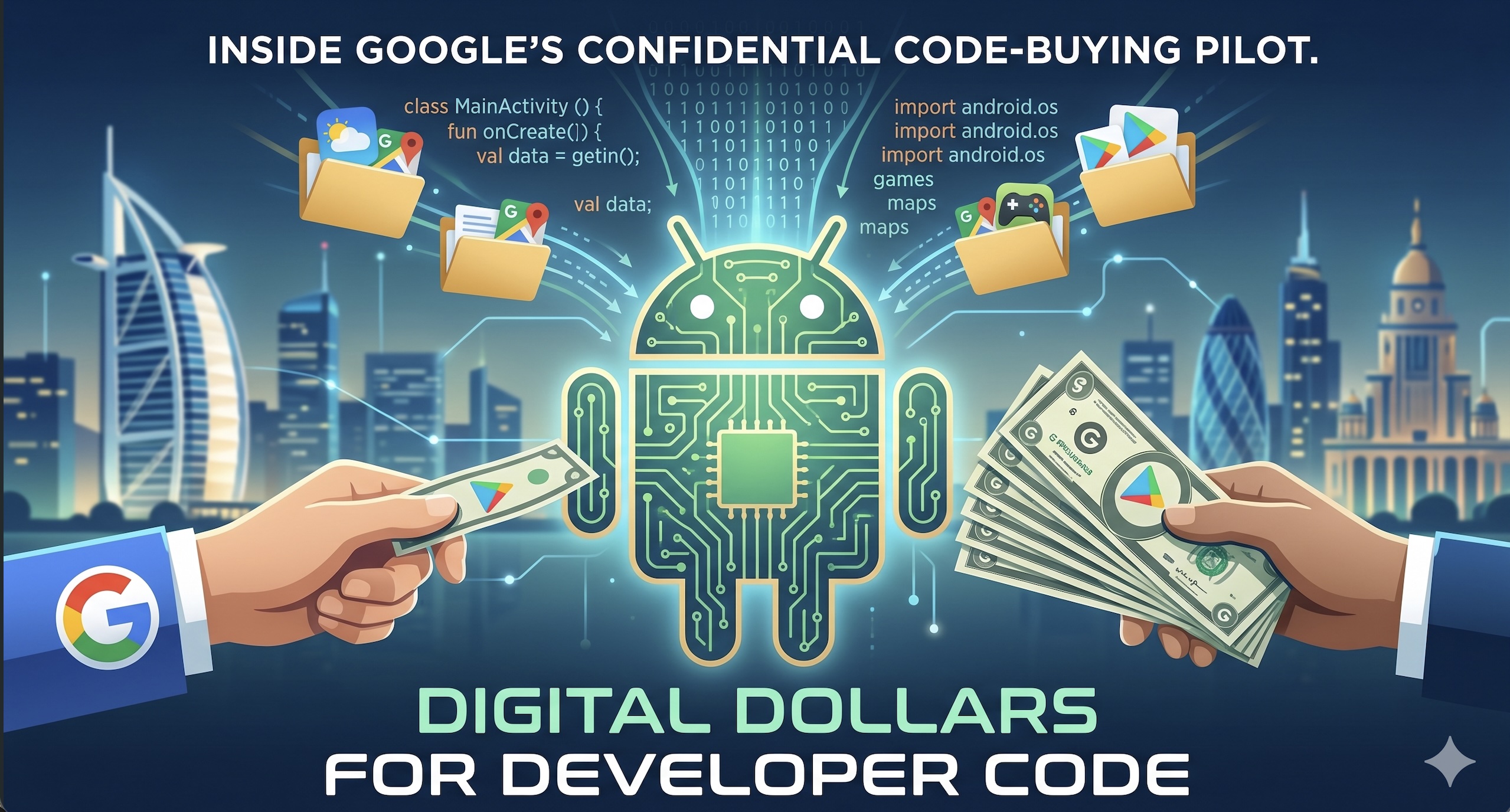
In a significant tactical pivot within the generative artificial intelligence landscape, Google has quietly initiated a program to pay Android application developers directly for access to their private codebases. Operating under a strict "confidential content offer pilot," the tech giant is extending financial incentives to select Google Play creators in exchange for licensing their active production repositories and dormant prototype archives.
This program marks a structural evolution in how multinational technology firms source high-fidelity data. As standard internet-scraping methods yield diminishing returns, the race to build superior machine-learning models is shifting toward highly curated, proprietary software assets. For software engineering communities spanning from Silicon Valley to India's major IT corridors in Bengaluru, Hyderabad, and Pune, this pilot establishes a brand-new monetization model for intellectual property.
Inside the "Confidential Content Pilot": What Google is Buying
The quiet rollout came to light after independent developers—including creators behind Android applications with millions of lifetime downloads—disclosed receiving targeted invitations from Google Play partnership teams. The communications explicitly state that Google is searching for "high-quality, real-world codebases to help improve Google's developer tools and products."
While the initial intake emails maintain a neutral tone, secondary terms and linked documentation tie the program to Google's specialized artificial intelligence training initiatives.
Key Frameworks of the Licensing Agreement
Broad Code Sourcing: Google is targeting an extensive array of data. This includes active production code powering live apps, as well as unreleased prototypes, architectural experiments, and abandoned side projects sitting in private archives.
IP Protection and Non-Exclusivity: The legal framework guarantees that participating developers retain 100% of their core intellectual property rights. The licenses granted to Google are non-exclusive, meaning engineers remain legally free to monetize, sell, or deploy their codebases elsewhere.
A New Secondary Revenue Stream: By framing the initiative as an opportunity to unlock value from dormant assets, Google is transforming non-performing technical artifacts into direct cash-flow generators for independent studios and enterprise software houses alike.
The AI Code Generation Race: Sourcing High-Quality Training Data
Google's decision to buy non-public code underlines a growing problem across the entire AI ecosystem: the data scarcity wall. Publicly available code repositories scraped from open-source platforms are no longer sufficient to train advanced, production-grade LLMs.
Real-world codebases are highly valuable because they contain complex logic, edge-case error handling, production workarounds, and cross-functional design patterns that rarely exist in clean, synthetic datasets or basic educational tutorials.
Competing AI Coding Assistant | Primary Parent Organization | Market Standing & Adoption Metrics |
Claude Code & Computer Use | Anthropic PBC | Riding massive adoption waves; driving a private corporate valuation that outpaces early OpenAI trajectories. |
GitHub Copilot | Microsoft Corporation | Widely adopted standard for integrated development environments (IDEs); deeply entrenched in enterprise workflows. |
Project IDX & Gemini Code Assist | Google LLC | Actively scaling; utilizing targeted private code acquisitions to close technical gaps in structural reasoning. |
Google’s direct-purchase strategy is heavily informed by past data acquisition experiments. The company famously finalized a $60 million data-licensing agreement with Reddit to feed its conversational models.
However, engineering teams reported that general internet forums yielded mixed results due to unstructured formatting, slang, and varying content quality. By pivoting directly to professionally maintained app repositories, Google ensures it feeds its neural networks clean, syntactically sound data.
Platform Dynamics and the Developer's Dilemma
For independent software creators and mobile engineering shops, Google's offer presents a compelling yet complex business case. On one hand, the ability to generate revenue from legacy codebases that are otherwise collecting digital dust is a massive benefit, particularly for smaller studios navigating a tighter venture capital market.
However, the confidential nature of the pilot introduces complex platform dynamics. Several developers who leaked details of the program insisted on strict anonymity, citing fears of algorithmic penalties or platform retaliation within the Google Play ecosystem.
Because Google acts as both the marketplace gatekeeper and a direct competitor through its own application ecosystem, developers are highly sensitive to the power imbalance.
To balance these competitive tensions, Google's documentation positions the pilot as a mission-driven contribution to the broader tech ecosystem. Corporate materials emphasize that the ingested data will optimize tools designed to automate debugging, accelerate code refactoring, and democratize software creation globally.
Shifting Paradigms in the Intellectual Property Economy
The success of Google's code-purchasing pilot will likely establish a clear precedent for how major technology companies approach model training moving forward. The industry is rapidly shifting away from unauthorized web scraping toward a formalized, compensated data economy.
As corporate entities realize that specialized datasets hold immense strategic value, creators of high-quality content—whether they write novels, produce artwork, or architect Android codebases—will find themselves holding leverage in negotiation rooms.
For the global software engineering community, the pilot signals a structural transition where an engineer's historical repository may ultimately prove just as valuable as the live application running in the app store.