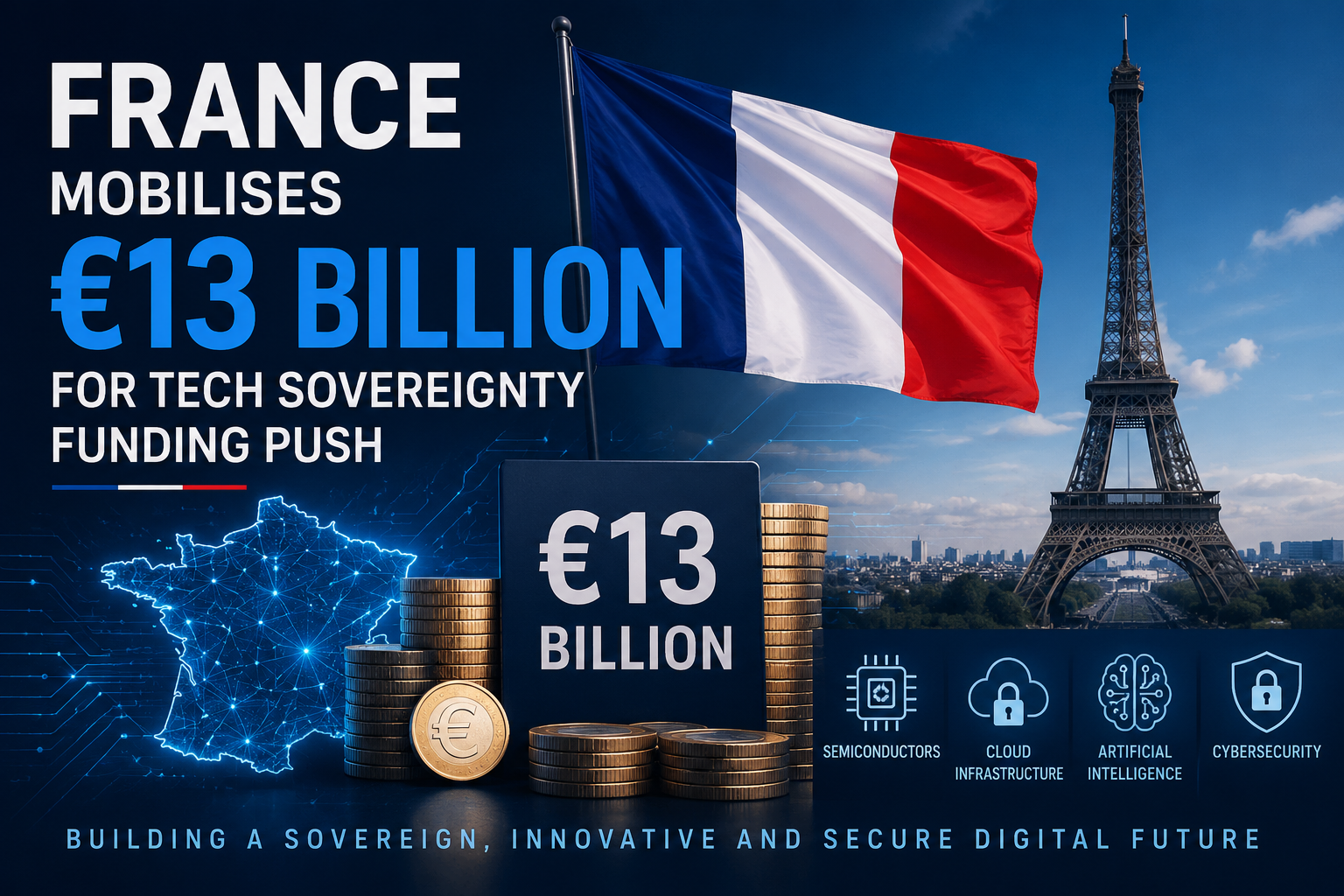
New Tibi initiative secures €13 billion from institutional investors, accelerating France's deep tech drive towards €15 billion by 2030.
France has injected a significant €13 billion into its domestic technology sector, marking a pivotal acceleration in the nation's ambitious drive for tech sovereignty and sending a clear signal across global venture capital markets. This substantial capital commitment, primarily flowing from institutional investors under the renewed Tibi initiative, is set to supercharge the European deep tech landscape, directly impacting the valuations and growth trajectories of startups poised to define the next generation of industrial innovation.
The new funding tranche, secured through a concerted effort between the French government and major institutional players, aims to propel France towards its €15 billion investment target by 2030. Half of this freshly mobilised capital is specifically earmarked for deep tech ventures, reflecting a strategic pivot towards foundational technologies such as artificial intelligence, quantum computing, advanced materials, and sustainable energy solutions. This strategic allocation underscores a broader European imperative to cultivate indigenous technological capabilities and reduce reliance on foreign tech giants, fostering a more resilient and independent digital economy.
Paris is positioning itself as a leader in this continental push, leveraging its robust research infrastructure and a growing pool of skilled engineers. The Tibi initiative has proven instrumental in redirecting long-term capital from pension funds and insurers into venture capital and growth equity funds, thereby addressing the historical funding gap for late-stage European tech companies. This latest infusion represents not just a numerical increase but a qualitative deepening of institutional commitment to the innovation ecosystem.
What It Means
My read is that this initiative is far more than a simple capital injection; it is a profound declaration of intent, fundamentally altering the risk-reward calculus for deep tech investors in Europe. For founders, particularly those building capital-intensive, long-horizon technologies, this represents a crucial lifeline and a potent validation of their ventures. The availability of patient, institutional capital can significantly de-risk the scaling phase, allowing companies to focus on R&D and market penetration rather than being perpetually constrained by shorter VC fund cycles.
The ramifications extend beyond French borders. As France actively nurtures its deep tech champions, it inadvertently creates a stronger magnetic pull for talent and follow-on private investment across Europe. This could trigger a positive feedback loop, attracting more global investors who perceive a more stable and well-capitalised ecosystem. We could see an uplift in European deep tech valuations, potentially narrowing the multiple gaps that have often existed when comparing European startups to their Silicon Valley counterparts, ultimately creating more liquidity events and exits.
France has secured €13 billion in new funding for technology firms, with half designated for deep tech, aiming for €15 billion by 2030 to bolster national tech sovereignty.
Background
The Tibi initiative was initially conceived to bridge the scale-up funding gap for French tech companies. While early-stage venture capital in France has seen significant growth over the past decade, driven by a vibrant startup scene and government support programs like Bpifrance, securing substantial late-stage funding for companies has historically been challenging. European institutional investors, traditionally more risk-averse, have often shied away from venture capital, preferring more liquid or established asset classes.
President Emmanuel Macron's vision of France as a "Startup Nation" has been a consistent driver behind these policies. His administration has systematically worked to create a more attractive environment for entrepreneurs, from simplifying company formation to implementing tax incentives for R&D. This €13 billion mobilisation builds on previous efforts to mobilise capital from institutional investors, and demonstrates a maturing understanding of the capital needs required to compete on a global stage in critical technological domains.
This push for tech sovereignty aligns with broader European Union efforts, such as the European Chips Act, which seeks to boost semiconductor production within the bloc, and the European Innovation Council (EIC), which provides funding and support for breakthrough innovations. The collective objective is to ensure that Europe can control its own digital destiny, from hardware manufacturing to advanced software development, reducing strategic dependencies on geopolitical rivals and ensuring data privacy and security for its citizens.
Globally, the competition for technological leadership is intensifying. Nations like China and the United States have consistently poured vast sums into their tech ecosystems, often via state-backed funds or massive private capital pools. France's proactive stance is a recognition that without significant, sustained investment, Europe risks falling further behind in critical areas like AI, quantum computing, and biotech – sectors that will define economic power and national security in the coming decades. This capital injection is not merely about job creation, but about securing a strategic foothold in the future global economy.
What to Watch
The critical next steps involve the effective deployment of this capital into high-potential deep tech ventures. Investors and policymakers will be closely monitoring the types of companies receiving funding, the speed of allocation, and the tangible impact on innovation output and market growth. Key indicators will include the number of new deep tech unicorns emerging from France, the volume of intellectual property generated, and the ability of these companies to attract further international private capital in subsequent funding rounds.
Beyond capital deployment, attention will shift to the regulatory environment and talent development. France must continue to cultivate a supportive ecosystem that not only funds but also nurtures deep tech companies through complex regulatory landscapes and ensures a steady supply of top-tier scientific and engineering talent. The interaction between this public-private capital initiative and existing European regulations, especially around data governance and AI ethics, will be crucial in shaping a distinctively European approach to technological advancement. The coming years, leading up to the 2030 target, will reveal whether this ambitious financial commitment translates into true technological leadership and strategic autonomy.
Frequently asked questions
What is France's new tech funding initiative?
France has launched a new funding push under the renewed Tibi initiative, mobilizing €13 billion from institutional investors to boost its domestic technology sector. The goal is to reach €15 billion by 2030, primarily supporting deep tech firms.
How much funding has France secured for its tech sector?
France has secured €13 billion in new funding for its technology firms.
What is the Tibi initiative?
The Tibi initiative is a French government-backed program aimed at mobilizing institutional investor capital for the nation's tech sector, particularly deep tech.
What is the target for tech funding by 2030?
The aim is to reach €15 billion in tech funding by 2030.
Which types of firms will benefit from this investment?
Half of this new investment is earmarked to support deep tech firms.
Who are the primary investors in this funding push?
The primary investors are institutional investors contributing under the Tibi initiative.