GM faces union fury after deploying 50 'cobots' at its Detroit plant, displacing over 1,000 human workers amid an automation push.
General Motors is making headlines, but not for its latest electric vehicle or groundbreaking innovation. Instead, the automotive giant is facing a significant backlash from labor unions after replacing over a thousand human workers with just 50 robots at its main Detroit assembly plant. This isn't just a local issue; it’s a stark illustration of the accelerating tension between technological advancement and the livelihoods of everyday people.
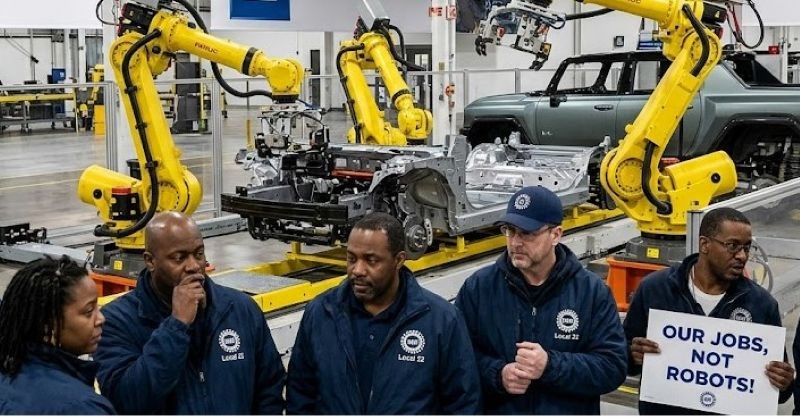
Here’s what happened: GM deployed "collaborative robots," or cobots, at its Michigan facility, specifically designed to work alongside remaining human staff on the assembly line, attaching vehicle body panels. While GM frames this as a move to boost competitiveness, improve safety, and enhance ergonomics, the immediate consequence for more than 1,000 workers is job loss.
This deployment comes after GM reportedly softened its EV commitments, indicating a strategic pivot within its manufacturing operations. The company’s spokesman, Kevin Kelly, confirmed the installation is part of a broader push to integrate advanced technology across its manufacturing footprint. Yet, for the United Auto Workers Local 22 President, James Cotton, these machines are simply taking jobs. Cotton expressed concern about robots coming to a plant, especially after layoffs, and stated that the union was disgusted by the presence of cobots in their plants.
It's worth noting that this automation push is happening while GM is in a strong financial position, reporting a healthy $4.25 billion in profits in the first quarter of 2026, a 22% increase from the previous year. This profitability only amplifies the union's frustration, raising questions about corporate responsibility in an era of rapid technological change.
Why This Matters So Much
For me, as someone who watches the global tech and startup ecosystem closely, this GM story isn't an isolated incident; it's a microcosm of a much larger, global trend. The industrial sector, particularly manufacturing, has always been an early adopter of automation, from the earliest assembly lines to today's AI-driven robotics. What's different now is the speed and scale of deployment, driven by advancements in machine learning, sensor technology, and more affordable, flexible robotic systems.
The push for automation isn't just about cost savings, though that's certainly a factor. It's about precision, consistency, and the ability to operate in environments that might be dangerous or ergonomically challenging for humans. In a fiercely competitive global market, especially for automakers, the pursuit of efficiency is non-negotiable. Companies like GM are under immense pressure to optimize production to compete with rivals, many of whom are also heavily investing in automation. This isn't just a Detroit story; it’s playing out from Stuttgart to Shenzhen, as every major manufacturer looks to future-proof their operations.
My read on this is that the venture capital flowing into industrial automation and robotics startups is fueling this revolution. We're seeing incredible innovation in everything from collaborative robots, like the ones GM is deploying, to fully autonomous factory systems and AI-powered quality control. These startups are creating solutions that promise higher output, fewer defects, and greater flexibility, making it increasingly difficult for legacy manufacturers to ignore. The problem, of course, is that these advancements often come at the expense of human jobs, creating a significant societal challenge that extends far beyond the factory floor.
The Human and Economic Ripple
The immediate impact on over a thousand families in Detroit is profound. These aren't just numbers; they represent individuals with mortgages, families, and community ties. The argument from companies often centers on "upskilling" or "reskilling" the workforce, but the reality is that the pace of job displacement often outstrips the availability or accessibility of effective retraining programs, especially for an older workforce. This creates an economic ripple effect in communities heavily reliant on manufacturing jobs, potentially leading to decreased consumer spending, higher unemployment rates, and increased strain on social services.
Beyond the immediate job losses, there's a broader question about the nature of work itself. As more routine and even complex tasks become automated, what does the future hold for human labor? This isn't just about factory workers; we're seeing similar trends in logistics, retail, and even some white-collar professions. The conversation needs to shift from simply lamenting job losses to proactively investing in new industries, fostering entrepreneurship, and developing educational frameworks that prepare the next generation for roles that complement, rather than compete with, advanced AI and robotics.
For the auto industry specifically, this is a pivotal moment. The transition to electric vehicles already requires significant retooling and a different skill set. Adding aggressive automation into the mix complicates the picture even further. Unions like the UAW are faced with the difficult task of balancing the need to protect existing jobs with the undeniable march of technological progress. Their long-term strategy will likely involve negotiating for retraining programs, job placement assistance, and potentially even advocating for policies that ensure a share of automation-driven productivity gains benefits the wider workforce, perhaps through higher wages for remaining jobs or broader social safety nets.
Ultimately, GM's decision, while defensible from a purely business-efficiency standpoint, highlights a critical juncture for our society. The innovation coming out of the startup ecosystem is powerful and transformative, but its deployment demands a more thoughtful, collaborative approach between corporations, labor, and government. The future of work isn't just about what machines can do; it's about how we, as a society, choose to manage the transition to ensure prosperity is broadly shared, not just concentrated at the top.
Frequently asked questions
Why is General Motors facing backlash over robot integration?
General Motors is facing backlash because it replaced over 1,000 human workers with 50 robots at its Detroit plant. Labor unions, particularly UAW Local 22, are protesting the job losses, despite GM's claims of improved safety and competitiveness.
How many jobs did GM cut at its Detroit plant?
General Motors cut over 1,000 jobs at its main Detroit assembly plant.
What kind of robots did GM install?
GM installed 50 "collaborative robots," or cobots, which work alongside human staff on the assembly line.
What is GM's stated reason for using robots?
GM stated that the cobots are necessary to stay competitive, improve safety, and enhance ergonomics for workers.
Who is protesting GM's automation decision?
Trade unions, specifically United Auto Workers Local 22 President James Cotton, are protesting the job cuts and robot installations.
What were GM's profits in Q1 2026?
GM reported $4.25 billion in profits in the first quarter of 2026, a 22% increase from the previous year.