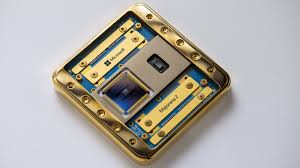
The global race for fault-tolerant, utility-scale quantum computing has dramatically accelerated. At its annual Build conference, Microsoft Corporation unveiled Majorana 2, its latest second-generation topological quantum processing unit. The new hardware delivers a staggering 1,000-fold improvement in qubit reliability compared to its predecessor, shifting the paradigm of quantum architecture.
Crucially, this engineering milestone has allowed Microsoft to compress its commercial roadmap, declaring that a scalable, fault-tolerant quantum supercomputer capable of solving commercially valuable problems will be ready by 2029—effectively cutting the company’s original timeline in half.
Engineering Stability: Breaking the Millisecond Qubit Barrier
The fundamental hurdle facing the entire quantum computing industry has long been "decoherence"—a vulnerability where traditional superconducting or trapped-ion qubits lose their delicate quantum states within mere microseconds or milliseconds due to minuscule environmental fluctuations, temperature changes, or vibrations.
Microsoft's Majorana 2 hardware directly targets this fragility through a fundamentally distinct, topological approach.
Key Performance Thresholds of Majorana 2
Extended Coherence Lifetimes: Qubits on the Majorana 2 chip maintain their quantum state for a mean lifetime of 20 seconds, with peak instances holding coherence for up to a full minute. Competing quantum architectures typically measure coherence in fractions of a millisecond.
The Power Analogy: Microsoft hardware engineers compare this reliability leap to transitioning from a standard smartphone battery that requires daily charging to one that operates continuously for three years on a single charge.
Miniaturized Footprint: The topological qubits operate at swift speeds of one microsecond per operation while maintaining a physical footprint of just 1/100th of a millimeter. This ultra-compact profile is vital for the eventual scaling phase, which will require packing millions of uniform qubits onto a single production system.
Materials Science Revolution: The Shift from Aluminum to Lead
For nearly two decades, Microsoft has focused its R&D on topological quantum computing, a technique that exploits the mathematical properties of a theoretical quasi-particle first predicted by Italian physicist Ettore Majorana in the 1930s.Rather than storing data within the properties of a single isolated particle, a topological qubit splits and stores quantum information non-locally across pairs of Majorana particles, making it inherently more resistant to external errors.
The 1,000-fold reliability surge introduced in Majorana 2 stems from a major materials stack upgrade. Researchers swapped out the traditional aluminum-based superconductors used in earlier devices for a specialized material stack incorporating lead (Pb), antimony (Sb), and indium arsenide.
Lead acts as a dense, high-performance superconductor that naturally shields the fragile wires from cosmic radiation and external magnetic jitter. This shift successfully increased the "topological gap"—a core metric of qubit protection—by a factor of more than 2X over the previous hardware generation.
Driven by Agentic AI: The Role of Microsoft Discovery
While human intuition guided the baseline shift toward lead superconductors, the sheer speed of development was made possible by a powerful technological convergence: using advanced artificial intelligence to build quantum hardware. Microsoft developed and optimized the Majorana 2 architecture using Microsoft Discovery, its newly generalized agentic AI research platform.
By deploying teams of autonomous AI agents overseen by human scientists, Microsoft automated the tedious testing cycles that previously took weeks of manual labor. The AI agents executed complex, parallel voltage adjustments to find the optimal operational sweet spots of the chip, rapidly resolving the manufacturing and fabrication trade-offs historically associated with lead-based chemistry.
Macro-Dynamics: The Global Supercomputing Race
The quantum ecosystem is expanding across major global corridors, pushing corporate laboratories and government agencies into intense competition. As Microsoft scales its topological approach, rivals are moving quickly with alternative qubit designs.
Developer / Institution | Core Quantum Architecture | Current Strategic Focus |
Microsoft Quantum | Topological (Majorana quasi-particles) | Scaling 12-qubit chips to fault-tolerant systems by 2029. |
IBM Quantum | Superconducting Transmon Circuits | Scaling multi-chip processors via heavy multi-billion-dollar investments. |
Google Quantum AI | Superconducting Gate-Based Systems | Validating error-correction codes while maximizing classical system limits. |
DARPA (US Defense) | Multi-Platform Validation | Assessing utility-scale quantum system designs for security applications. |
This international sprint has profound implications for global technology hubs, with organizations like NATO, the European Union, and research centers across India, Japan, and North America tracking validation data closely.
To prove the commercial viability of its design, Microsoft is participating in the final stage of the US defense research agency DARPA's quantum development program. The company has opened its sensitive workings and internal data to external verification.
Remaining Hurdles and the Road to 2029
Despite the enthusiasm surrounding the Build announcement, the wider scientific community maintains a degree of healthy skepticism. Topological quantum computing has a complex history, including the high-profile retraction of a 2018 Nature paper regarding early Majorana evidence.
Furthermore, critics note that the current Majorana 2 hardware is still a small-scale prototype featuring 12 topological qubits. Scaling from a 12-qubit test chip to a functional, error-corrected supercomputer capable of running complex algorithms will require expanding the architecture to support millions of reliable qubits.
If verified by independent peer reviews, Microsoft's accelerated 2029 timeline opens up massive commercial possibilities. By combining generative AI, classical hyper-scale cloud networks, and stable topological quantum chips, industries could compress decades of research down to a matter of months. This hybrid approach promises to revolutionize molecular simulation, streamline the removal of microplastics, and unlock next-generation clean energy materials.